Often, in our debates about education, we tend to gloss over what should do a foundational piece of the conversation; namely, the question of what our schools are actually for. What is the ultimate purpose of our education system? What does it mean to be well-educated?
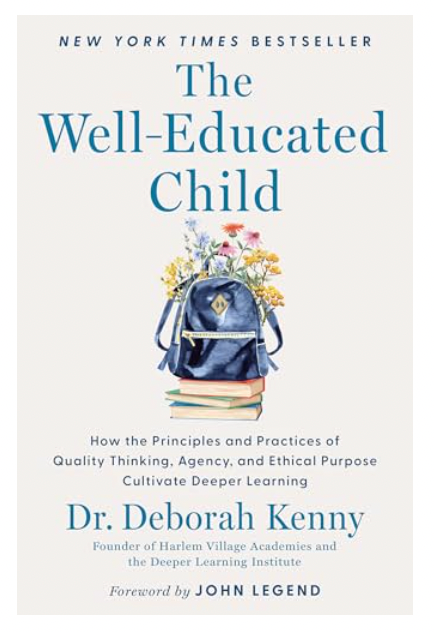
This is why I was delighted to read the new book The Well-Educated Child, by Dr. Deborah Kenny, founder of the Harlem Village Academies, one of the highest performing charter school networks in the country. In the book, Kenny starts by facing these questions head on, outlining her vision of what it means to be well-educated, and what a school ought to be for. She then describes how she designed her schools around that remarkably ambitious vision.
On the second page of her book, Kenny lays out her vision of what it means to be well-educated.
“In my view, students who are well educated can reason independently, understand ideas deeply, and evaluate information critically. They are self-directed and self-motivated. Students who are well educated are too astute to be duped by misinformation; they are independent minded but not irrational, confident but not arrogant, spirited but civil in discourse. They are kind, happy, and considerate of others, not self-centered and stressed. They have cultivated an appreciation for beauty: the beauty of art, of music, the beauty of math. They are knowledgeable and well-read but have the humility to know how much they don’t know. All this is what I wanted for my own children. It is what I believe all children deserve.”
There are notable omissions from this vision, including student performance on standardized tests and being “college and career ready.” This is because Kenny’s vision is far more ambitious than what is typically laid out as the aim of education. She articulates, correctly, that the aim of education cannot be reduced to test scores or discrete skills, but rather must be centered on equipping students with the knowledge and capacities to navigate and make a meaningful contribution to the world.
This is important because an education designed around the capacities Kenny describes looks entirely different from one designed around boosting scores on standardized tests or equipping students with “career ready” skills. In Kenny’s words, an education designed to build the capacities she envisions is “cognitively demanding, with intriguing questions that spark intellectual curiosity and cultivate intrinsic motivation.” It centers a curriculum that “immerses students in the world’s great books, ideas, and thinkers.” It features assessments that “require students to demonstrate their ability to apply knowledge and skills in unfamiliar contexts.” And it is built around a school culture that “teaches self-management and instills an abiding moral compass and a sense of purpose.”
This is much different, and far more ambitious, than a school designed to achieve high scores on state assessments. She should know. By the late 2000s, just several years after launching her schools, HVA students, who largely come from low-income families, were outscoring their peers not only in New York City but in wealthy suburbs as well. In 2007 they were the top-ranked school in New York State on the 8th grade math exam; the next year 100% of their students earned proficiency in math; when their high school opened, 100% of students passed the New York Regents exam. Presidents and mayors and Oprah celebrated the school.
But Kenny was not satisfied. Though her schools had closed the gap in standardized test scores between her students and their peers in wealthy suburban districts or private schools, she saw an entirely different gap that they had not yet touched. She writes, “Schools in Chappaqua, Scarsdale (wealthy New York suburbs), schools like Sidwell Friends (a private school in DC where presidents send their kids): They did not define achievement as good behavior and passing state tests. They believe that schools should prepare students, as the Sidwell Friends brochure said, to ‘analyze, question, critique, and interpret information and ideas,’” and to “nurture a person rooted as much in the unseen as in the seen.” She writes, “My dream was for our children in Harlem to receive a world-class education on par with such a grand vision. To me it was glaringly obvious, all evidence to the contrary notwithstanding, that we had not yet accomplished this.”
She realized that a curriculum and pedagogy designed to develop these broader, higher-order thinking capacities is entirely different from one designed to do well on standardized tests. So she collected educators she admired from across the country to help her redesign her schools – schools that were already “high achieving” by any available metric – and established a set of design principles for what high quality teaching and learning looked like. These included designing a curriculum built not around a list of topics to cover, but around a set of big ideas to explore and engaging questions to answer; placing responsibility on the students to carry out ambitious individual projects from start to finish; ensuring that all students, even the youngest students, are able to explain what they’re doing in the classroom, and the purpose of their work; and ensuring that students, rather than teachers, were doing most of the talking, and the heavy intellectual lifting, in the classroom. She wanted her students to be well-read, and have a deep and broad base of knowledge because, after all, you can’t really think critically about something unless you first know something about the topic at hand.
And, perhaps most importantly, because she knew that what is assessed is what gets taught, she also redesigned the way her students are assessed. Kenny writes, “Assessment drives everything that happens in a school: curriculum, instruction, calendars, budgets, schedules, lesson plans, and ultimately the entire educational experience of the child.” Kenny is skeptical that multiple choice tests, and even more rigorous standardized assessments, like the New York Regents exam or AP exams, are up to the task. Kenny notes that these kinds of exams are problematic because they direct teaching and learning toward a narrow set of capacities that don’t necessarily align with college readiness, while ignoring a whole suite of activities – like analytic essays and extended research projects – that students will have to produce repeatedly to be successful in college.
Kenny notes that it’s for precisely this reason that private college-prep schools don’t participate in state exams. Rather, they develop their own performance-based assessments – research papers, analytical essays, mathematical proofs, authentic science experiments, consulting projects with real-world clients that have real stakes – that both help to develop and assess for the capacities students will need to be successful in college and navigate an ever-changing economic landscape.
This all led her to seek accreditation for her schools from International Baccalaureate, an international organization that provides guidance, support, and accreditation to schools around the world seeking to deliver a rigorous college-preparatory model of teaching and learning. IB aligned with Kenny’s aims because the model focuses on “deep reading, academic discourse, research, and extended writing,” and assesses through performance assessment, requiring students to not only demonstrate that they know something, but to “demonstrate their ability to transfer knowledge and skills to novel contexts.” Her description of what she values in the IB assessments is worth quoting at length:
“IB assessments require both knowledge and the ability to apply knowledge as well as strong writing and oral presentation skills across all disciplines. The IB literature exam, for instance, has students write several extended essays. The first requires them to reference multiple texts that they have covered in class in answer such questions as ‘In what ways are “the contradictory” or “the paradoxical” significant aspects of at least two of the works you have studied?’ A second has them analyze a series of texts that have not been covered in class. Essays are graded on higher-order cognitive skills such as interpretation and analysis as well as on organization and focus. The oral exams ask students to analyze a literary text and a set of nonliterary texts through the lens of an important issue. Both the essays and the oral exams are evaluated by the world’s most experienced IB teachers, selected and trained to ensure that the organization’s global standards are applied consistently.
Imagine the brilliant teaching and learning necessary for students to be prepare dot do well on such assessments.”
Kenny’s book is well worth a read. In describing what it means to be well-educated, and describing the kind of education needed to become well-educated, Kenny provides a blueprint for what we should want for all Michigan kids, and some ideas for how we should be designing our schools to ensure all Michigan kids receive a high-quality education.