
Last week, we shared some data on how young college graduates are doing in the labor market. Conventional wisdom suggests they’re not doing well. The popular press is filled with stories about young adults with a BA unable to find a job, or working for low pay in jobs that don’t require a BA largely because, it is suggested, AI can now do what has traditionally been considered entry-level white-collar work.
As we detailed in the post, the data tells a different story. 25–34-year-olds with a BA or more earn, on average, $30,000 more than their peers with an associate’s degree and more than $40,000 more than their peers with no education beyond high school. The data also show that the vast majority (nearly 80%) of 25-34-year-olds earning $100,000 per year have a BA.
One question we’ve been getting since we shared this data is: what are all these $100,000 jobs these young adults with a BA are working? Another popular narrative is that if one does get a BA, the only worthwhile degree is in a STEM field, and particularly the Technology part of STEM. Does this narrative hold with the data?
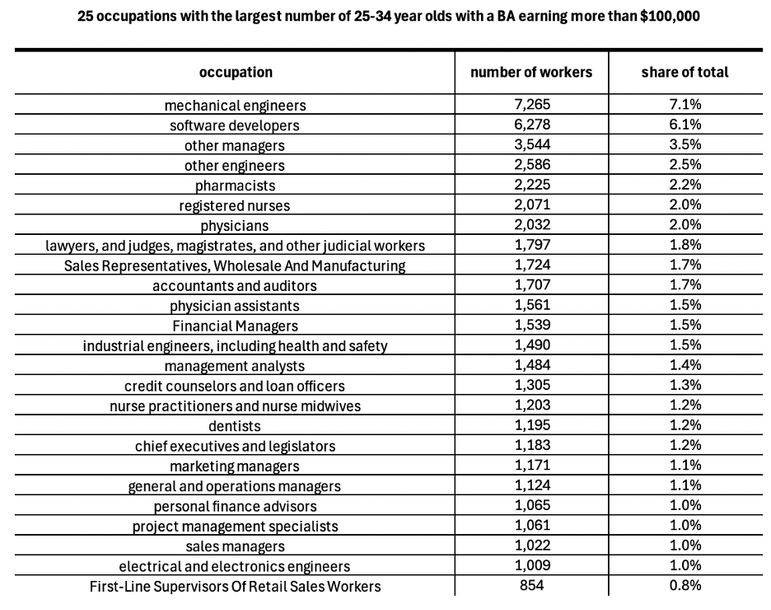
To help answer that question for young Michiganders, we looked at data from the American Community Survey to analyze the occupations of all 25-34-year-olds with a BA in Michigan earning $100,000 or more. According to the ACS, there are just over 81,000 25-34-year-old Michiganders with a BA earning $100,000 or more. And, indeed, a fair number of the high earners do work in STEM fields. The profession with the highest share of young high earners is mechanical engineers, at 8.9% (roughly 7,300) followed by software developers, at 7.7% (roughly 6,300).
But, perhaps surprisingly to many, while a fair number of high-paying jobs are in technology, broadly defined, technology does not dominate the list of high paying jobs. Across all young Michiganders with a BA earning $100,000 or more, roughly 11,000, 13.5% of them, work in a job related to computers and technology. This includes software developers, web developers, database architects, hardware engineers, programmers, etc., but does not include folks with another job function (like marketing or sales) who happen to work for a technology-related firm.
So, a decent number of high-paying jobs held by young adults with a BA require technical computer skills – but more than 85% of them do not. What are all these other jobs?
One dominant characteristic of many of these other jobs is they tend to have “manager” or “supervisor” in the title. These are jobs where one is either charged with managing people (first-line supervisors, operations managers), and/or broad portfolios of work (marketing managers, financial managers) in which they must deploy a broad array of skills. If you look across all $100,000 plus jobs worked by 25-34-year-olds with a BA, you’ll find that more than 1 in 5 of those jobs (22%) have manager or supervisor in the title. We have been making the case that in the economy of the coming decades, those with broad, generalist skills will be best set up to thrive. It is likely the case that these managerial and supervisory positions are filled by folks with generalist skills.
But even beyond computer and managerial jobs, there remains a broad diversity of occupations represented in the set of $100,000 plus jobs worked by young adults with a BA. Pharmacists, nurses, physicians, lawyers, sales reps, accountants, physician assistants, management analysts, loan officers, nurse practitioners, dentists, and personal finance advisors all account for at least 1,000 of the 81,000 high-wage jobs worked by young adults with a BA in Michigan.
The point is, not only are young adults with a BA doing just fine, but young adults with a BA are doing fine across a wide variety of fields. Below is a table of the 25 occupations with the largest number of 25-34-year-olds with a BA earning at least $100,000, the number of young adults with a BA in that occupation earning at least $100,000, and that figure’s share of the total number of 25-34-year-olds in Michigan earning $100,000.
$100,000 jobs for young workers without a BA
What about 25-34-year-old Michiganders without a BA? What does the market of high-paying jobs look like for them?
First, mirroring the national figures, there are about a quarter of the number of $100,000+ jobs for young adults without a BA as there are for those with a BA; while 81,000 25-34-year-olds with a BA in Michigan are earning $100,000 or more, just 21,000 of the same age group without a BA in Michigan are earning six figures.
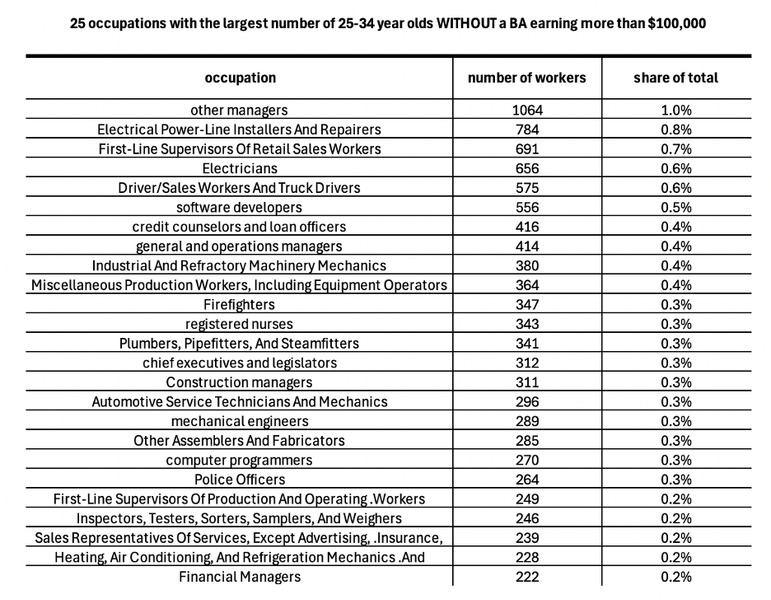
But what are these high-paying jobs these young adults without a BA are working? One thing you notice from the outset is that, just as with the BA jobs, managerial positions play a leading role. The occupation with the largest number of 25-34 non-BAs earning at least $100,000 is “other managers.” And occupations with the word “manager” or “supervisor” in the title make up 23% of all $100,000 non-BA jobs held by 25-34-year-olds.
So, once again, in a world in which everyone seems to be telling young people that they need to find a particular trade or specialized skill to thrive, it turns out that those with the broad, generalist skills managerial positions require are doing quite well, even in the sub-BA labor market.
This is not to say that there are no high-paying jobs for young folks who learn a trade or specialized skill. There are hundreds of 25-34-year-old Michiganders without a BA who work as electric power-line installers and repairers, electricians, firefighters, nurses, or plumbers, and earn $100,000. But there are also hundreds of 25-34-year-old Michiganders without a BA who work in a range of other professions that get little, if any, attention, where there is also a pathway to highly paid work. To cite just one example, the data show there are just as many 25-34-year-olds without a BA earning $100,000 as first-line supervisors of retail sales workers as there are 25-34-year-olds without a BA earning that same amount as electricians. The latter occupation gets a lot of attention in the popular press and workforce development ecosystem, while the former gets virtually none.
We also must remember that with any of these sub-BA occupations – the electrician or the sales supervisor – the pathway to highly paid work is very narrow. There are roughly 1.2 million 25-34-year-olds in Michigan with at least a high school diploma, but less than a BA. Just 21,000 of them – 1.7% of them – earn $100,000 per year. Meanwhile, 16% of 25-34-year-old Michiganders with BA earn $100,000. So, yes, it’s possible to earn high wages even if you don’t have a BA, but the opportunities are fewer.
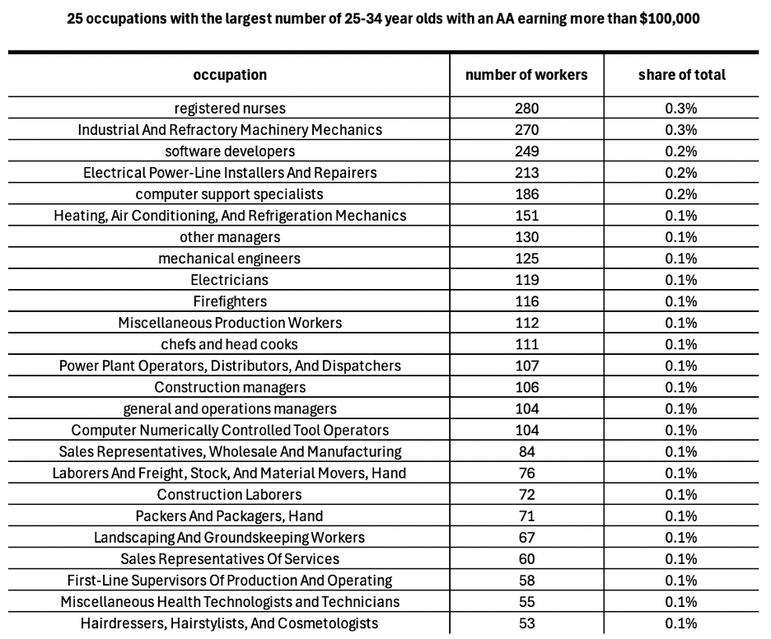
Below are four tables. The first shows the 25 occupations worked by the largest number of 25-34-year-olds without a BA earning $100,000; the number of 25-34-year-olds without a BA earning $100,000 in each of those occupations; and the share of the total number of 25-34-year-old Michiganders earning $100,000 this represents. This last figure is included in part to remind folks of how broad and varied the labor market is – both the overall labor market and the market for high-paying jobs. It’s fine to encourage kids to go into a specific trade, but we must remember that any particular trade represents only a small share of the total economy and a very small share of the high-paying jobs. The final three tables show this same information, but broken down for all sub-BA education levels: associate degree, some college but no degree, and no education beyond high school.
(It should be noted that some occupations will show up in multiple tables, representing the number of 25-34-year-olds earning $100,000 in that occupation with a particular level of educational attainment).