
This year the Detroit Regional Chamber’s Mackinac Policy Conference will begin with a session that proclaims that Michigan’s “House Is On Fire,” detailing the facts, including those grounded in Michigan Future’s data, that Michigan has indeed become a poor state over the past 25 years.
That, of course, raises the question “how do we put the fire out?” We tried answering that question in testimony we presented to the Growing Michigan Together Council in summer 2023. Those remarks remain viable and worthy of consideration. We present them to you here (data has been updated with most recent figures):
Michigan was a 20th Century high-prosperity state. Now, we are a 21st Century poor state. We rank 40th in per capita income, 13 percent below the national average in 2024. This is the lowest Michigan has been in per capita income compared to the nation – ever.
The core reason for this unprecedented collapse in economic well-being is that the Michigan economy has too many low-wage jobs. A state that once attracted people from across the planet to get high-paid jobs is now a state with average wages seven percent below the nation’s. Six in ten Michigan jobs pay less than middle income wages.
Michigan can return to high-prosperity – a place where all can pay the bills and save for their retirement and the kids’ education. But that requires a willingness to make big changes in state policy. What we have been doing to increase the economic well-being of Michiganders has not worked. A small course correction to our economic and education agendas will not be sufficient – transformational change in both is required if we are to restore Michigan to high-prosperity.
Over three decades of rigorous data analysis has taught us one fundamental lesson: this is an economy where talent attracts capital. As you can see in the table below, with the exception of the energy extraction states of Wyoming, Alaska, and South Dakota, in every state with per capita income above the nation’s the most consistent predictor of economic success is the share of its adults – particularly young adults – with a four-year degree. Where young talent goes, high-growth, high-wage, knowledge-based enterprises follow, expand, and are created. The new path to prosperity is concentrated talent.
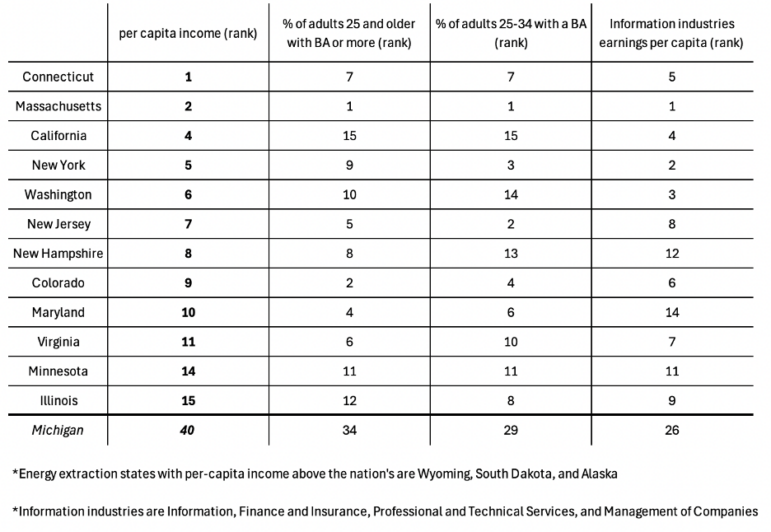
To put it simply, either Michigan gets younger and better educated, or we will get poorer.
Michigan needs to get younger by retaining those who grow up here and attracting mobile talent from any place on the planet. And Michigan needs to get better educated by increasing the proportion of adults – particularly young adults – who have a four-year degree or more.
Preparing, retaining, and attracting young talent is the 21st Century economic development imperative. If we do everything else that we call economic development, but don’t get younger and better educated, Michigan will permanently be one of the nation’s poorest states.
The Getting Younger Imperatives
Talent attracts capital and quality of place attracts talent. So getting younger requires economic development policies squarely focused on creating the kinds of places where highly-educated young people want to live and work. The data show that highly-educated young people are increasingly concentrating in regions that are first and foremost transit rich and offer multiple vibrant central city neighborhoods that are high-density, high-amenity, walkable, and have an active street life.
The Michigan Future Board believes the high-impact getting younger levers are:
- Being welcoming to all, no matter where one is born, one’s sexual orientation, race, religion, or ethnic background.
- Providing extensive transit as the 21st century infrastructure that matters most to retaining and attracting young talent.
- Creating talent magnet neighborhoods: dense, walkable, high-amenity neighborhoods with parks, retail, and the arts woven into residents’ daily lives.
The Getting Better Educated Imperatives
Getting better educated requires transforming Michigan schooling: both what we teach and how we teach. We need schooling where students are engaged, not bored; where all students are developing agency to create and realize their own dreams; and where all students develop the broad non-content and non-occupation specific skills that will enable them to keep learning and adapting in a world characterized increasingly by constant change.
To thrive in the new economy, workers have to be adaptable, have a broad base of knowledge, be creative problem-solvers, and be able to communicate and work well with others. In other words, workers need to be really good at all of the non-algorithmic skills computers aren’t good at yet.
More specifically the Michigan Future Board believes the high-impact getting better educated levers are:
- Establishing communication, collaboration, content, critical thinking, creativity, and confidence as the foundational career success skills for all Michigan students.
- Substantially improving college completion rates – particularly BA attainment rates – of all Michigan high school graduates from all backgrounds.
- Start messaging – particularly to non-affluent students – that a four-year degree is the most reliable path to a successful forty-year career. No high-prosperity, racial equity, or economic mobility agenda can succeed without a substantial increase in BA attainment for non-affluent students.
Getting younger and better educated requires a new policy agenda
If we make the tough decisions and the big investments, we can see a Michigan with a growing population, prosperous citizens from all backgrounds, and neighborhoods that rival the best in our nation. But that future only happens with decisive action to successfully transition to the high-wage knowledge economy by investing in our young people, and creating vibrant cities that attract talent from across the globe. If we do not, we will continue to get older and poorer and be a place people, particularly young adults, are moving from, not moving to.