

Michigan didn’t become a low-wage state by losing manufacturing. We became a low-wage state by failing to build what came next.
Lou Glazer from Michigan Future recently shared data showing that over the last thirty years Michigan has gone from being a high-wage state to being a low-wage state. The data is powerful, but what’s the story behind the data? Ask most people, and they’ll probably tell you Michigan’s decline in prosperity was caused by a loss of manufacturing jobs. After all, as the home of the American auto industry, our state was uniquely exposed to globalization, automation, and increased competition from foreign automakers building factories in southern states. If we’d held onto more of those factory jobs, Michigan would still be a high-wage state.
That’s the story many people in Michigan believe, but is it true?
Did Michigan lose more manufacturing jobs than other states?
From 1990 to 2025, Michigan lost nearly 244,000 manufacturing jobs, which was about a 29% decline. That sounds bad, but it was actually pretty average. The country as a whole shed more than 5 million manufacturing jobs over that period, and those losses were widespread: 80% of states had a decline. Nineteen states lost a greater share of their manufacturing jobs than Michigan, and eight states lost more total jobs. New York alone lost over 577,000 manufacturing jobs, which was a reduction of nearly 60%.
So whatever happened to Michigan, “we lost factories” can’t be the distinguishing explanation. Whether it was computers in Massachusetts, textiles in North Carolina, or consumer electronics in New Jersey, almost every other state lost factories too.
Did losing manufacturing jobs reduce wages in other states?
New York, Massachusetts, New Jersey, and Connecticut were among the top five for manufacturing job losses.1 Collectively, those four states accounted for over 1.3 million lost manufacturing jobs – more than a quarter of the nation’s total. Today those four states have some of the highest wages in the country. In fact, of the ten highest wage states in the US today, eight of them lost a higher share of their manufacturing jobs than Michigan did (the only two states that didn’t were Washington and Colorado, which I’ll say more about later).
To be clear, losing factories didn’t make these states better off. The impact of job losses on workers, families and communities was devastating wherever it happened. But those job losses didn’t determine the fate of the broader state economy.
| State | Mfg Job Change (1990-2025) (thousands) | Mfg Loss % (1990-2025) | Mfg Loss Rank (1990-2025) | Avg Wage 2025 | Avg Wage Rank 2025 |
| New York | -577.6 | 58.8% | 1 | $99,970 | 2 |
| Massachusetts | -253.9 | 52.8% | 3 | $100,126 | 1 |
| New Jersey | -277.1 | 52.4% | 4 | $86,268 | 6 |
| Connecticut | -146.8 | 49% | 5 | $91,013 | 5 |
| Michigan | -243.7 | 29.4% | 20 | $70,837 | 23 |
Did Midwestern states that retained more manufacturing jobs than Michigan fare better? What about the southern states we’ve been competing with?
Both Indiana and Wisconsin retained a higher share of manufacturing jobs than Michigan, but it didn’t help them become high-wage states. Both are near the bottom third for average wages, with workers in both states earning roughly $5,000 per year less than in Michigan. Those southern states that we often think of as competing for Michigan’s jobs? Tennessee, South Carolina, and Louisiana all lost 20% to 30% of their manufacturing jobs, and all of them have lower average wages than Michigan.
| State | Mfg Job Change (1990-2025) (thousands) | Mfg Loss % (1990-2025) | Mfg Loss Rank (1990-2025) | Avg Wage 2025 | Avg Wage Rank 2025 |
| Michigan | -243.7 | 29.4% | 20 | $70,837 | 23 |
| Tennessee | -143.4 | 28.7% | 21 | $70,369 | 25 |
| South Carolina | -85.7 | 24.6% | 25 | $63,752 | 36 |
| Louisiana | -36.0 | 20.4% | 27 | $63,089 | 41 |
| Indiana | -88.7 | 14.6% | 31 | $65,078 | 34 |
| Wisconsin | -66 | 12.6% | 34 | $66,183 | 32 |
How did other states become or stay high-wage states?
It turns out the states that stayed or became high-wage states were not the ones that avoided job loss. They were the ones that replaced good-paying manufacturing jobs with even better paying jobs in growing sectors. A high-wage job is simply one that pays more than the average job in the state. That includes manufacturing jobs, which in Michigan pay about 21% above the state average. But three growing sectors pay even more: information (software, data, and telecom), financial activities (banking, insurance, and real estate), and professional and business services (engineering, law, accounting, and corporate management). In Michigan those pay 61%, 36%, and 32% above the state average, respectively. The states that came out ahead didn’t just defend their old high-wage jobs. They grew even better ones.
What kind of jobs did Michigan gain?
Since 1990, Michigan’s largest job gains have come mostly in sectors that pay below the state average. Michigan saw the biggest gains in sectors like educational and health services, where the 319,700 jobs created pay about 11% less than state average, and leisure and hospitality, where the 98,500 new jobs pay nearly 59% below average. Michigan did grow in some high-wage sectors, but only by 37.6%, increasing the total share of high-wage jobs from 16.9% to just 20.5%.
While Michigan was focused on Ohio and Tennessee, we should have been looking at Washington and Colorado. In 1990, Washington had the exact same percentage of high-wage jobs as Michigan: 16.9%. But while Michigan only grew its high-wage employment by 37.6%, Washington grew employment in high-wage sectors by 139% and raised its total share to 23.9%. Colorado also more than doubled employment in high-wage jobs, and grew its share of high-wage jobs by nearly 3 percentage points.
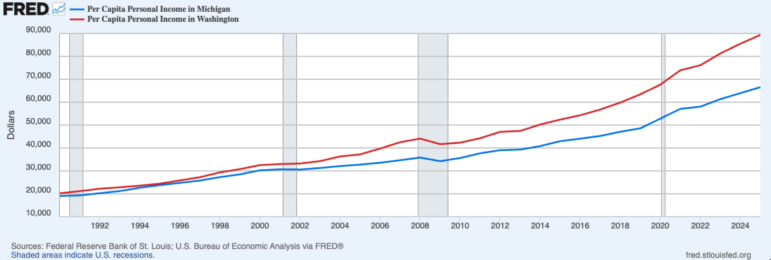
What does that mean in practice? In 1990 Michigan and Washington looked similar: Washington was 15th in per capita income and Michigan was 20th, and the average Washingtonian only made about $1000 more than the average Michigander. But as Washington added high-wage jobs, its per capita income climbed to 5th in the country. Meanwhile, Michigan mostly added low-wage jobs, and it fell from 20th to 39th. Today, the average Washington resident makes more than $20,000 a year more than the average Michigander.
What went wrong in Michigan?
For the last 35 years, Michigan has been trying to do something that is close to impossible: sustain prosperity by defending a sector that was shedding jobs nationally and gradually losing some of its wage premium. In 1990, manufacturing paid about 25% more than the average private-sector job in America. Today that premium is down to about 13%, and falling. We placed a lot of bets on holding ground in a sector that was both shedding workers and slowly losing its wage edge. That does not mean manufacturing no longer matters. It remains one of Michigan’s most important sources of good-paying, broadly accessible jobs. But manufacturing alone can no longer carry the state economy.
The deeper mistake is that we misunderstood our own advantage. The auto business in Michigan was never just about manufacturing. At its best, it was about manufacturing and innovation. The engineering, design, R&D, and now the software, are what drive growth. The manufacturing jobs are what spread the benefits of that growth across a broad middle class.
Michigan spent three decades fighting with states that were already poorer than us to keep the manufacturing half, and in our focus on the assembly line we turned a blind eye to the states getting wealthier than us that were taking the innovation half. Rivian moved its headquarters to California. GM is consolidating its tech workforce in Silicon Valley. Ford launched its EV skunkworks in Long Beach. The world’s most advanced self-driving vehicle companies are headquartered in Northern California, Austin, or China, not Detroit. The car has become a computer on wheels, and the people inventing the software and hardware that will define it are increasingly being hired somewhere else.
Michigan Future has been right about talent.
When Mary Barra announced the opening of a Silicon Valley technical center, she said that GM would “go where the talent is.” That phrase sums up what Michigan Future has been arguing for more than two decades: the path to prosperity lies in attracting and retaining a greater share of young, college-educated workers. Lou points out that Michigan ranks 34th in the share of adults with a four-year degree, and that average wages track educational attainment almost perfectly. That’s exactly right. High-wage industries cluster where the talent is. What’s also true is that talented people move to where the high-wage jobs are. Michigan’s failure to grow high-wage sectors and its failure to grow and keep a college-educated workforce aren’t two problems. They’re the same problem. Without the jobs, the graduates leave; without the graduates, the jobs go elsewhere.
Increasing educational attainment isn’t just a good strategy for workers with a college degree. As states increase their share of college-educated workers, wages go up for all workers, including those without degrees. As Michigan has become a low-wage state, median earnings for workers at every educational attainment level have declined compared to workers in other states. That means the median Michigan worker with only a high school degree earns more than $2,000 less than the national median for workers with the same level of education. In Massachusetts, by contrast, the median worker with only a high school degree earns about $6,000 more than the national median.2
Start investing in people.
There’s a temptation to look at high-wage states for clues about which industries could put Michigan back on a path to prosperity. But just like Tennessee, Louisiana and South Carolina weren’t able to become high-wage states by copying Michigan, Michigan won’t be successful trying to copy Washington or Colorado. The lesson of the last 35 years is that placing bets on a single industry is inherently risky. The investment that has delivered a return for high-wage states is people.
Michigan has made progress on this front. Governor Whitmer’s Sixty by 30 initiative made educational attainment a signature state goal. Michigan Reconnect gives adult learners a path to tuition-free community college degrees and credentials. The Michigan Achievement Scholarship expanded college affordability for recent high school graduates. Increased apprenticeship funding has helped more Michiganders enter skilled trades. This is a great start, but we need to do more. We need education and workforce systems that make readiness the default: high school graduates prepared for college or a career, adults able to retrain without starting over, and employers confident that Michigan has the talent base to support high-wage growth.
“Go where the talent is” isn’t just GM’s hiring strategy, it’s the force that is driving our entire economy. New technologies like AI won’t reverse this trend, they will accelerate it. It’s not too late for Michigan to become a high-wage state, but only if we stop looking to the past and start investing in our future.
Jonathan Smith is the founder and principal of Mobilis Works, a strategy and implementation practice focused on policy innovation, economic competitiveness, and civic capacity. You can find his writing on Substack at mobilisworks.substack.com.
- Manufacturing employment is annual average state manufacturing employment from BLS CES/SAE, 1990 and 2025. Average wage is QCEW annual average pay for all covered employment, 2025. Rankings are among the 50 states. ↩︎
- American Community Survey (ACS) 2024 1‑year release, table B20004. ↩︎