The story of the underemployed college graduate refuses to die. If you look back across the past half century, it is not hard to find articles in major media outlets discussing the declining economic prospects of college graduates. The articles always feature a college graduate or two working as a bartender or a barista. This is the end, we are told. For years young people have been told to go to college, but now a four-year college degree only leads to under or unemployment, and lots of student debt.
The trouble with these stories, of course, is that data gets in the way. In a piece written just after the Great Recession, perhaps the last time anti-college sentiment reached the levels we see today, education writer Kevin Carey quotes a Washington Post story from 1980 decrying the economic prospects of college graduates, and profiling a bartender with a master’s degree. Of course, in the years after 1980 the college wage premium shot upwards: in 1980, the average four-year college graduate made roughly 40% more than the average high school graduate; today, it’s nearly 75%. As Carey wrote, “For going on four decades, the press has been raising alarms that college degrees may no longer be a sound investment. Two things about these stories have remained constant: They always feature an over-educated bartender, and they are always wrong.” The overeducated bartender the Post profiled went on to be an international development consultant.
Indeed, the reason these stories are always wrong is because they are always anecdotal. Everyone seems to know someone (a nephew, a friend’s nephew, a nephew’s friend) who has a college degree but is “underemployed” – bartending or bagging groceries instead of putting their degree to use. The message in these stories is often that young people should go into a “trade,” which is billed as a far more dependable path to economic security than a bachelor’s degree.
But we should not be making public policy, or advising high school students on potential career paths, based on anecdotes. Rather, we should be using representative data. Though I wish your nephew well, what he is doing or not doing with his degree is not helpful for informing public policy. Rather, for the purposes of advocating for public policy or advising high school students, we ought to be looking at the economic well-being of all young Michiganders or the average young Michigander with varying levels of educational attainment, to see how they’re doing economically. This kind of broad, representative data is the only kind of data we should be using to inform public policy.
Luckily, we have this data. Every year, the Census Bureau deploys the American Community Survey, in which they ask tens of thousands of Michigan adults dozens of questions about their education, economic circumstances, and living conditions. This survey yields, without a doubt, the largest sample of young people in any survey deployed in the state. In the 2024 survey, the Census Bureau got responses from more than 11,500 25-34-year-olds in Michigan. These responses are then weighted to ensure this sample is representative of the entire population of 25-34-year-olds in Michigan. If we’re trying to figure out how young folks are doing with varying kinds of education, this is as close to the gold standard as we’re going to get.
So, how are they doing? I first looked at all 25-34-year-olds with a bachelor’s degree or more. First, 89% of this group is working, and just 2.5% of this group is unemployed, meaning they are looking for work but can’t find work. So, the employment rate for this group is really high, and the unemployment rate is really low.
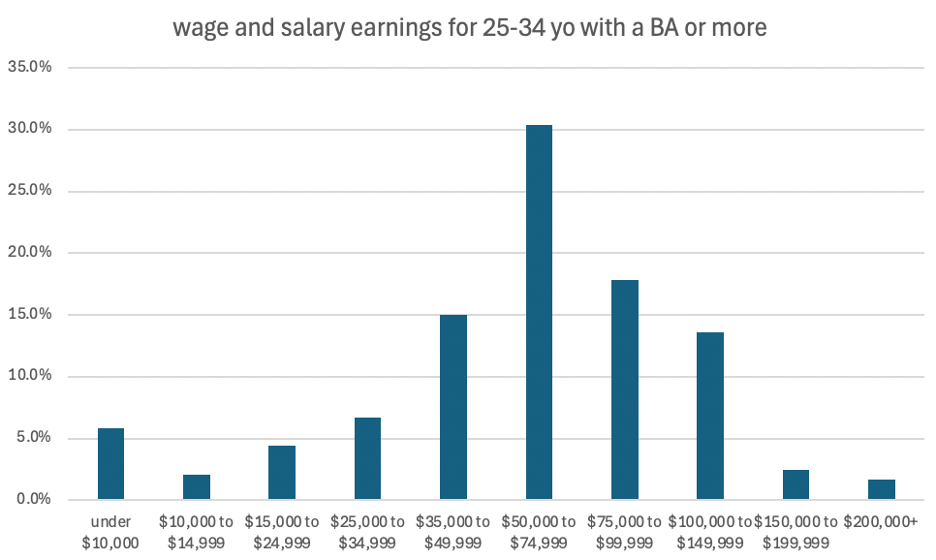
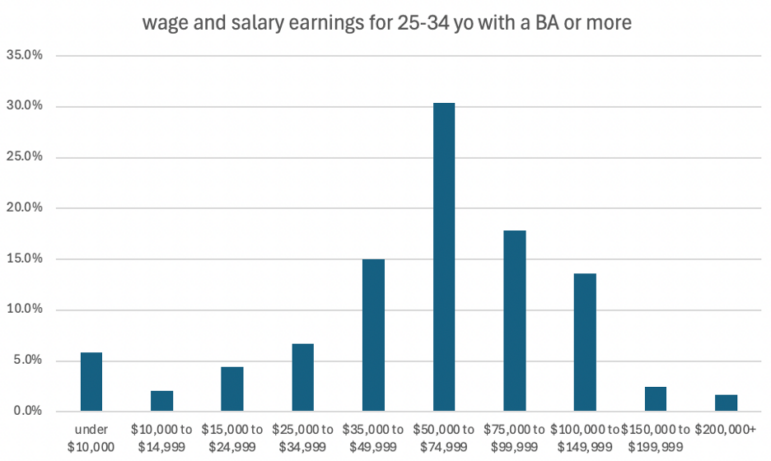
What about their incomes? The table below shows the distribution of incomes for all 25-34-year-olds with a bachelor’s degree or more in Michigan who report being employed. As you can see, while a bachelor’s degree doesn’t guarantee you a well-paying job relatively early in your career, it certainly increases your chances of obtaining one. Sixty-six percent of respondents had wage and salary income over $50,000, and 36% were earning over $75,000.
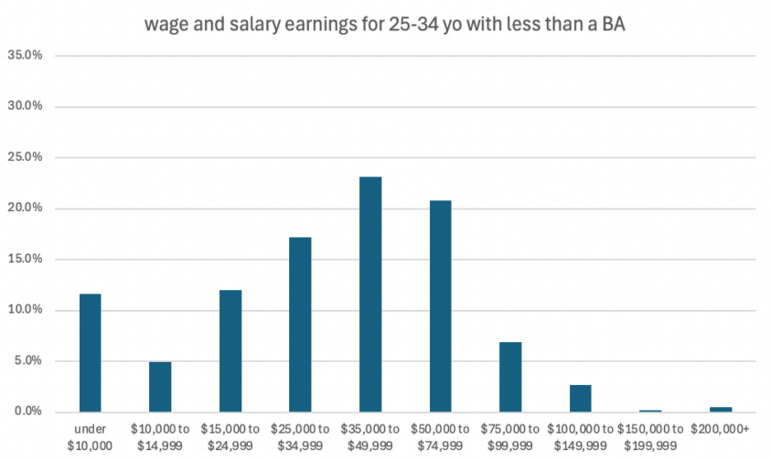
Outcomes are worse for those with education less than a BA. Here I look at all 25-34-year-olds with at least a high school diploma, but less than a bachelor’s degree. This includes those with no education beyond high school, those with some college but no degree, those with some sort of sub-BA credential, and those with an associate’s degree.
For starters, this group is less likely to be employed – just 77% of 25-34-year-olds with less than a BA were employed, and 7% were unemployed.
Of those who report being employed, we see lower incomes than with the bachelor’s group. Of this group, just 31% had wage and salary income over $50,000 (less than half the rate of those with a BA) and only 10% had incomes over $75,000 (less than a third the share as those with a BA).
This data makes it clear why drawing broad-based policy conclusions from anecdotes is misguided. Are there some young adults with a bachelor’s degree who are not doing well economically? Yes, of course. But are most young adults with a bachelor’s degree doing well economically? Also, yes.
The same is true of those with less than a BA. Are some young adults with less than a BA doing well economically? Yes. Are most young adults with less than a BA earning below a middle-income wage? Also, yes.
We need to be doing a much better job of providing the full picture of the labor market to young people, and of using the full picture of the labor market to inform public policy. It’s perfectly reasonable to say that it’s possible to make good money as an electrician, while in the same breath noting that two-thirds of young adults with a bachelor’s degree earn over $50,000 a year. In other words, the anecdotes are true, but so are the averages. If folks are going to share anecdotes, let’s make sure we also ground folks in data.