
When people make the argument that you don’t need a four-year degree to get a good-paying job, they will often say that you can make $100,000 as a welder. For one reason or another, welding has become the occupation that folks always seem to choose in making the argument that there are all sorts of good jobs for those without a BA. So, I thought it would be a good idea to take a close look at the data. How much money do welders in Michigan actually make?
I’m going to use two data sources. The first is the Bureau of Labor Statistics (BLS) Occupational Employment and Wage data. This is the gold standard because it’s employer reported data on the wages they actually pay out.
But I’m also going to include data from the American Community Survey (ACS). This is self-reported data, so is perhaps not as precise as the BLS set, but it has certain advantages over the BLS set as well. For example, if a welder is working multiple jobs, the ACS data will capture the total income the worker receives from those jobs, while the BLS data is simply reporting the wages earned from a single job. In addition, because the ACS data allows us to match occupation with personal characteristics, we can also see wages by age cohort, enabling us to see how welders do throughout the course of their career.
I’m going to contrast this earnings data for welders with earnings data for accountants. This is an arbitrary decision – I’m just choosing accountants because it’s a high-volume “knowledge” job that requires a BA. It’s a prototypical office job set against welding, a prototypical blue-collar job.
The data on welders
First, the BLS data. According to BLS the median income for welding jobs in Michigan is just $49,000, and the 90th percentile welder earns just $72,400. Based on this data, we can estimate that roughly 27% of welding jobs in Michigan pay at least $60,000 (our threshold for lower middle-class wages) and that no welders earn $100,000.
However, as stated above this data doesn’t tell the whole story. We are just working with averages here, and the BLS data is only reporting employer reported data on what jobs pay. There may indeed be outliers – welders that earn over $100,000 in jobs that don’t show up in the BLS data, or who work multiple jobs to bring in over $100,000.
On the whole, the ACS data tells much the same story as the BLS data. The median income for a welder, according to the ACS data, is $43,000, roughly in line with the BLS data. According to the ACS data, the 90th percentile welder earns roughly $70,000 – again, in line with the BLS data. And according to the ACS data, roughly 21% of employed welders in Michigan earn $60,000, again relatively close to the BLS estimate.
But the ACS data does allow us to see the outliers; and, indeed, it shows that roughly 3% of employed welders in Michigan earn $100,000 or more.
In other words, yes, it seems there are some welders in Michigan that earn $100,000. But there are not a lot of them.
And this is sort of the point when we’re having discussions about the value of a four-year degree, or whether you need a four-year degree to get a good job. It is, of course, possible to earn high wages without a BA. It’s just much rarer. So, if we’re trying to provide students with information about the most dependable paths to earning high wages, becoming a welder is probably not on the list. Can you make high wages? Yes. But you would be an outlier.
The data on accountants
Now, contrast this data with the data for accountants, a prototypical office job, which requires a BA. According to the BLS data, the median accountant earns $78,000, and the 90th percentile accountant earns $130,000. According to the ACS data, the median employed accountant earns roughly $60,000, and the 90th percentile accountant earns $130,000.
But what’s most interesting about the data, particularly as it relates to high school kids choosing career paths, is how the earnings of accountants grow over time compared to the earnings of welders. Research has consistently shown that the value of a BA is not necessarily seen in one’s first job out of college, but rather in one’s lifetime earnings. While the pay in most sub-BA occupations tends to be relatively flat throughout one’s career, pay in most occupations that require a BA tends to grow substantially throughout one’s career.
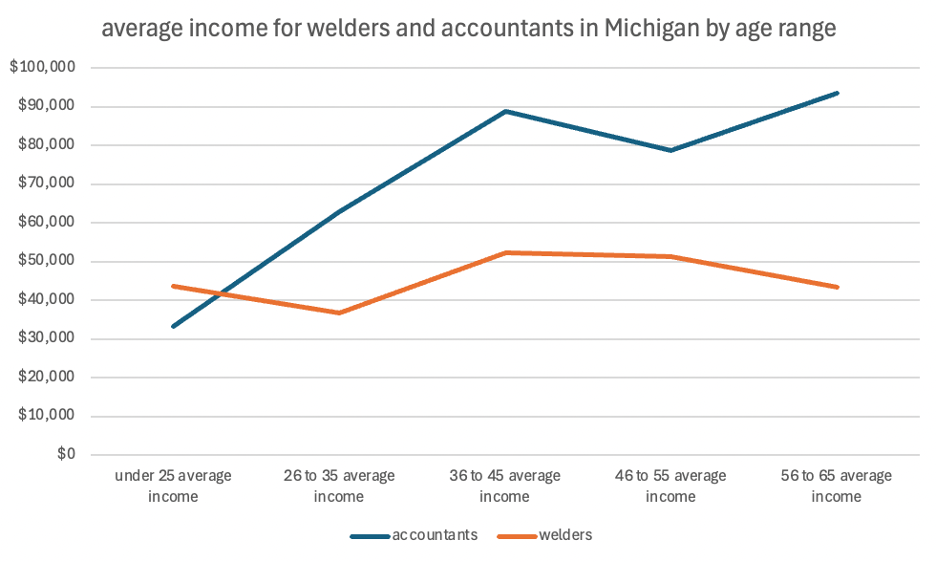
And we definitely see this phenomenon play out in the case of welders and accountants. Because the ACS data lets us see earnings by age, we can track how average earnings in various occupations may change throughout one’s career. As you can see in the chart below, the average welder under 25 in Michigan has earnings above that of the average accountant under 25. But after 25, earnings for accountants skyrocket, while earnings for welders remain basically flat.
All of this data needs to be taken into account when we’re advising high schoolers about what kinds of good jobs are available to them. Can you make $100,000 as a welder? Yes, but it’s not the norm. And while you might make decent money relative to your peers with a BA when your young, earnings tend to be flat throughout your career, whereas earnings will grow significantly for those with a BA.
None of this is to say a young person shouldn’t go into welding. If a young person wants to work with their hands or is interested in the kinds of industries that need welders, they should of course go into that occupation. We just need to be sure we are equipping young people with all the information they need to make their decisions, rather than relying on anecdotes.